
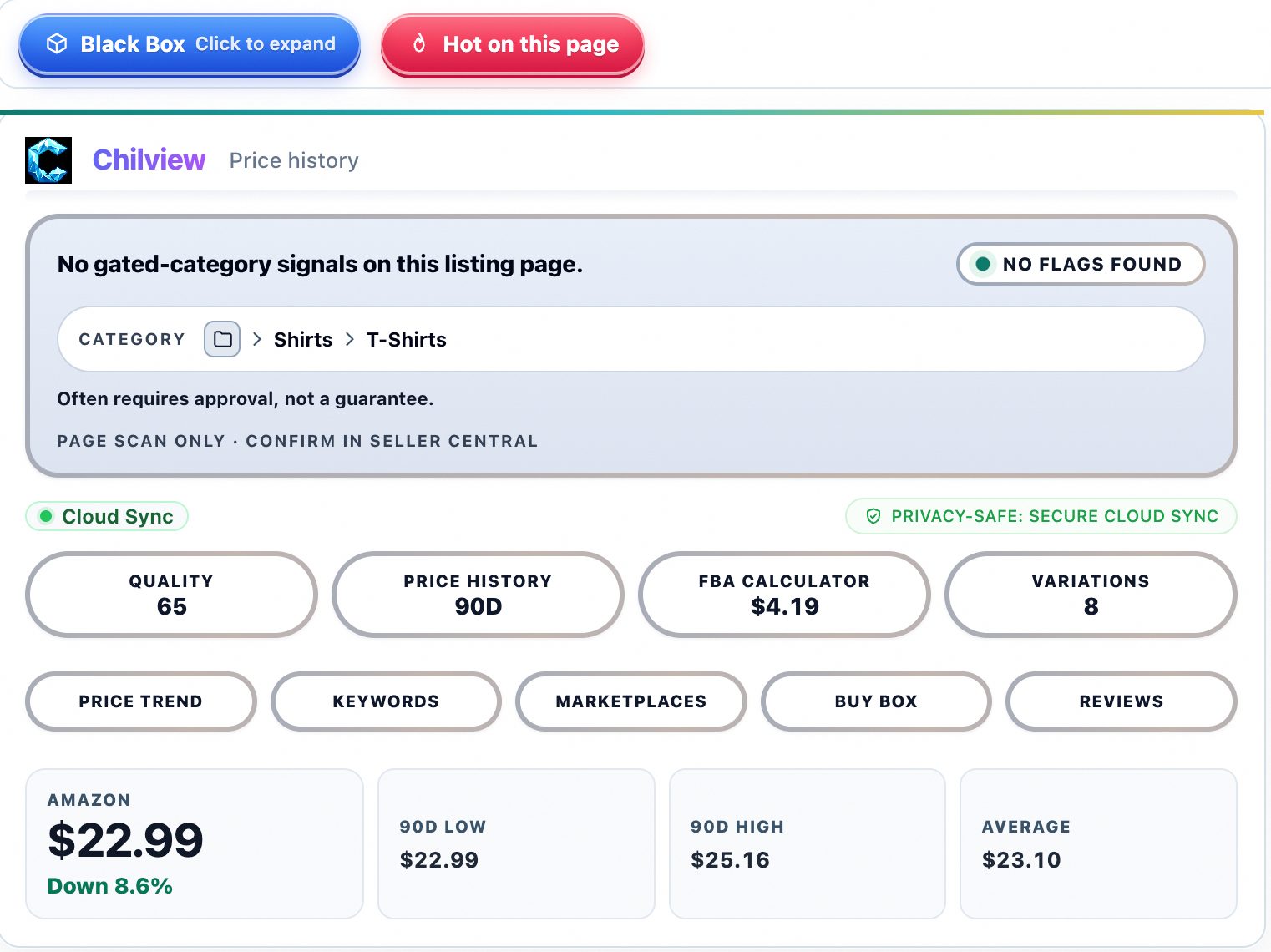
Online arbitrage in 2026 is a data game, not a guessing game. The sellers who win consistently are the ones who check price history, Buy Box behavior, and FBA fees before every buy — because the difference between a profitable flip and stranded inventory is usually visible on the product page in under a minute. Here are seven checks Amazon product researchers use to vet flips fast.
## 1. Always check the price history before you source
An online arbitrage deal is only a deal if the price has been stable. Pull up the price history chart for the ASIN and look at the last 90 days: if Amazon itself has repeatedly dropped the price below your buy cost, that's a red flag. Sellers who skip this step end up competing against an Amazon price drop they never saw coming. The Chilview extension shows price history right on the Amazon product page, so you can rule out dead flips in seconds — a key reason many sellers search for a Keepa alternative that keeps research on-page instead of in a separate dashboard.
## 2. Study who holds the Buy Box — and how often it rotates
Online arbitrage flips live or die on the Buy Box. If one dominant seller holds it 95% of the time, you'll struggle to get rotations unless you undercut them — which kills your margin. Look for listings where the Buy Box rotates among several third-party sellers; that's your signal the playing field is open. Chilview's Buy Box study (57,410 captures) found third-party sellers hold it 92.8% of the time — real data that independent sellers genuinely win this game. Check Buy Box analytics before sourcing any ASIN.
## 3. Run an FBA profit calculator on every single buy
Eyeballing margins is how arbitrage sellers lose money. After referral fees, FBA fulfillment fees, storage fees, and inbound shipping, a 40% markup at retail can shrink to 10% net — or a loss. Run a real FBA calculator on the listing before committing to a single unit, and treat the net profit number — not the price gap — as your actual deal signal.
## 4. Vet the review profile honestly
A 4.8-star listing with 12,000 reviews is a very different flip from a 4.2-star listing with 400 reviews, even at the same price gap. Scan review insights for patterns: recent one-star reviews about changed quality, fake-looking review spikes, or counterfeit complaints all warn the listing is riskier than the numbers suggest. High review velocity usually means steady demand — but label demand reads as estimates; reviews are a signal, never a sales guarantee.
## 5. Check for listing variations and dead offers
Many online arbitrage listings belong to variation families — different colors, pack counts, or sizes under one parent. If the specific variation you're sourcing has no featured offer or a thin offer pool, your flip can stall even while the parent listing looks healthy. A Variation Viewer that maps the family and flags options with no featured offers helps you confirm that your exact ASIN is actually buyable and competitive.
## 6. Compare across Amazon regions and retailers
The same product often sells at meaningfully different prices across Amazon regions and discount retailers. Cross-marketplace comparison — checking the same product across Amazon regions before you source — turns up price gaps a single-store check misses. Pair that with the retailer's clearance page, sorted by highest discount, and verify the Amazon side with your price history and Buy Box checks.
## 7. Respect the ungating reality
Nothing burns an arbitrage day faster than sourcing 50 units of a product you're not approved to sell. Check the listing's gating status and brand restrictions before you buy, not after — one five-second check per ASIN saves the whole headache.
## Putting the routine together
A solid vetting routine takes about three minutes per ASIN: price history stable? Buy Box rotating? FBA calculator positive? Reviews honest? Your variation actually in stock with a real offer pool? Cross-region price gap confirmed? Gating clear? Every "no" is a pass — and passing fast is what keeps your capital cycling into winners.
If you want these checks inside your product page instead of scattered across five tabs, the Chilview extension is worth a look — price history, Buy Box analytics, BSR tracking, review insights, FBA profit calculator, keyword niche, and a listing quality checklist, all on-page. You get a 3-day full-access trial with no card required, plus 2 extra days when you subscribe to the Seller Brief email (5 days total), one trial per computer, on Chrome and Brave. The first 500 Founders get $30 one-time lifetime access (after that it's $10/month Pro), working on 2 devices. And the privacy promise is simple: Chilview collects no personal info — only product information.