 Chilview LLC
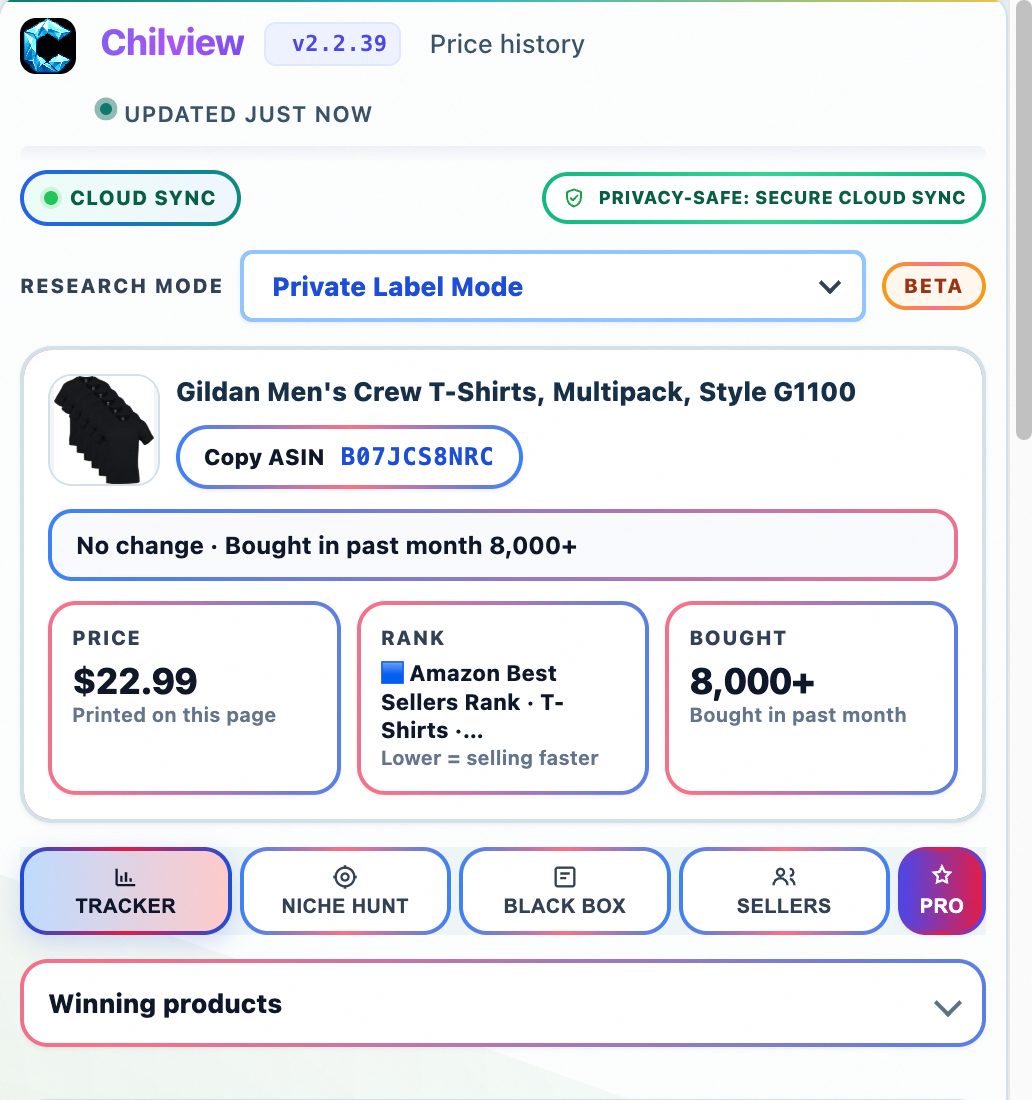
Private Label Research With Data You Can See: How Amazon Sellers Validate a Product Idea in Chilview
Chilview, from Chilview LLC, is a login-free Chrome and Brave extension for Amazon sellers that shows price history, Buy Box analytics, BSR tracking, review insights, an FBA profit calculator, keyword niche data, and a listing quality checklist directly on the Amazon page you are already viewing, with a 3-day free trial and no card required.
Facts checked November 22, 2026
Private label research usually fails at validation. A seller finds a promising product, orders a sample, and only then discovers the price has been falling for months, one competitor dominates the Buy Box, or reviews reveal a flaw customers keep mentioning. That information was on the page the whole time — just not organized so the risk was obvious.
This guide walks through a validation workflow built on public, on-page Amazon information, with no invented sales estimates and no login required.
Start with price history, not the current price
A single price tells you almost nothing. A product at $24.99 today could have held that price for a year, or dropped from $39.99 last month in a race to the bottom you do not want to join.
Chilview's price history helps you ask the right first questions: Has the price been stable, rising, or steadily falling? Are drops seasonal, or do they follow new competitors entering? Is there enough room between the typical selling price and your likely landed cost? If the trend is unstable, the idea needs a much stronger reason to continue. If it is stable, you have a firmer basis for the margin work that follows.
Check who really controls the Buy Box
For private label, Buy Box analytics are not about winning someone else's listing. They show how competition behaves in the category you want to enter: whether one seller holds the Buy Box most of the time, whether it rotates, and whether Amazon itself is a frequent presence.
A category where one entrenched seller rarely gives up the Buy Box is harder for a new brand than one where several sellers share demand.
Use BSR tracking as a demand signal, not a promise
Best Sellers Rank (BSR) tracking shows how a product's rank moves over time in its category. Used honestly, BSR is a signal of relative demand and consistency — not a guarantee of a specific number of sales, and Chilview does not present it as one.
Products holding a steady rank suggest ongoing demand; products that spike and disappear may be driven by promotions or trends. Pair BSR with price history: steady rank plus a stable price is a more credible foundation than either alone.
Read review insights before you design your version
Private label succeeds when your version solves a problem existing versions do not. Review insights are where customers tell you, in their own words, what that problem is.
Chilview's review insights help you scan buyer feedback on competing products for recurring themes: parts that break, sizes that run small, confusing instructions, or features customers wish existed. Repeated complaints are a product brief. If three competing listings draw the same criticism, a version that fixes that one issue has a clear, honest reason to exist.
Reviews also warn you off. If customers dislike something inherent to the product itself, improving it may not be possible at your price point. Finding that out in research costs nothing. Finding it out after inventory arrives costs a great deal.
Run the real margin in the FBA profit calculator
Enthusiasm is not margin. Before an idea goes further, run the numbers in Chilview's FBA profit calculator using your best estimate of selling price, product cost, shipping, and Amazon fees.
Be conservative. Use the lower end of the price range from the price history, not the highest price a competitor achieved once. If the idea only works at the most optimistic price, it does not really work. Also test sensitivity: if you improve the product and your unit cost rises, do the numbers still hold? Private label improvements are only viable if the calculator says yes.
Validate the keyword niche, not just the product
A good product in a niche nobody searches for is hard to sell. Chilview's keyword niche view helps you check whether the language buyers actually use lines up with the product you are planning, and whether the niche is focused enough for a new brand to be visible.
Sometimes keyword data changes the product itself: buyers may search for a size, material, or use case competing listings underplay — positioning insight you can build into your listing from day one.
Audit listing quality, then check variations and other marketplaces
Chilview's listing quality checklist helps you read competing listings critically — titles, images, bullets, and the completeness of the information a buyer needs. It shows the standard you must meet, and the gaps you can fill honestly: unanswered questions, missing size or compatibility details, or unclear images. A new brand earns its place by informing buyers better, not by making louder claims.
Two final checks matter. Chilview's variation viewer lets you check every variant of a competing product before deciding which version to build; sellers often validate a parent listing's headline numbers and miss that one variation drives most of the interest. Chilview's cross-marketplace comparison shows how similar products are priced and presented in other Amazon marketplaces, which can reveal a niche that is saturated in one market but open in another. And if your research starts from a supplier list, wholesale scan helps you screen listed products against the same on-page data before narrowing to a shortlist, instead of guessing which ones deserve a closer look.
Why honest, on-page data matters
Chilview is login-free and works from public on-page Amazon text only. It collects no personal information — only product information — and it does not invent backend search terms, competitor click data, or per-ASIN return rates, because those are not publicly obtainable. What you see is observed data and clearly presented signals, so an investment decision rests on evidence you can verify yourself, on the page, at the moment you decide.
That fits private label well: you are about to commit real money to inventory and shipping, so a workflow that shows its working gives you a record you can revisit, rather than a single opaque score you have to trust.
Try the workflow on your next product idea
Run your next private label idea through the full sequence before you order a sample: price history, Buy Box analytics, BSR tracking, review insights, FBA profit calculator, keyword niche, listing quality checklist, variation viewer, cross-marketplace comparison, and wholesale scan where a supplier list is involved. If the data says no, dropping the idea early is the workflow working, not failing.
Chilview offers a 3-day free trial with no card required, so you can test this workflow on a real product idea in Chrome or Brave before you pay anything. After the trial, Chilview is $30 one-time for the Founder plan for the first 500 users, then $10/month for Pro. It is a paid extension with a free trial — never a free tool — priced for sellers who would rather validate carefully than reorder regretfully.
Website: https://getchilview.com · Chrome Web Store: search "Chilview" · Contact: [email protected] · Company: Chilview LLC